📞 +256 760 424516 | +256 393 243363 | +256 706 303668 ✉ admin@netzahschoolug.ac.ug

FAQ
Frequently Asked Questions
❓ Frequently Asked Questions
FAQs
Yes! Netzah International School is a Christ-centred school. Biblical values are woven into every aspect of school life, our curriculum, and our culture while warmly welcoming all families.
We use the WEE Learn curriculum for Kindergarten (internationally recognised Christian early childhood education) and the Accelerated Christian Education (ACE) curriculum for Grades 1–12. We also offer our pioneering Coding & Robotics programme across all grades.
Yes, we offer school transport and a nutritious meal programme. Both are available at an additional cost. Contact the school office for route and meal menu details.
We’d love to show you around! You can call us on 0760 424516 or 0393 243363, email admissions@netzahschoolug.ac.ug, or visit us on working days between 8 am and 5pm, Monday to Friday. Our admissions team will be happy to answer all your questions and show your family around the campus.
The WEE Learn classes begin at age 3 (KG1 Baby Class) and run through to age 6 (KG3 Top Class). Children typically transition to Grade 1 after completing KG3.
WEE Learn (Weekday Early Education) is an internationally recognised Christian curriculum designed specifically for early childhood. It integrates Biblical principles into every subject and activity, uses a multi-sensory approach, and is used in schools across the world. Netzah is proud to be Uganda’s first and only pioneer WEE Learn school.
We’d love to show you around! You can call us on 0760 424516 or 0393 243363, or email admissions@netzahschoolug.ac.ug. Our admissions team will be happy to answer all your questions and show your family around the campus.
Daycare runs from 7:00 AM to 5:30 PM, Monday to Friday. KG1, KG2, and KG3 classes run from 7:30 AM to 1:00 PM, with optional extended care available until 5:30 PM. We also offer half-day options for younger children.
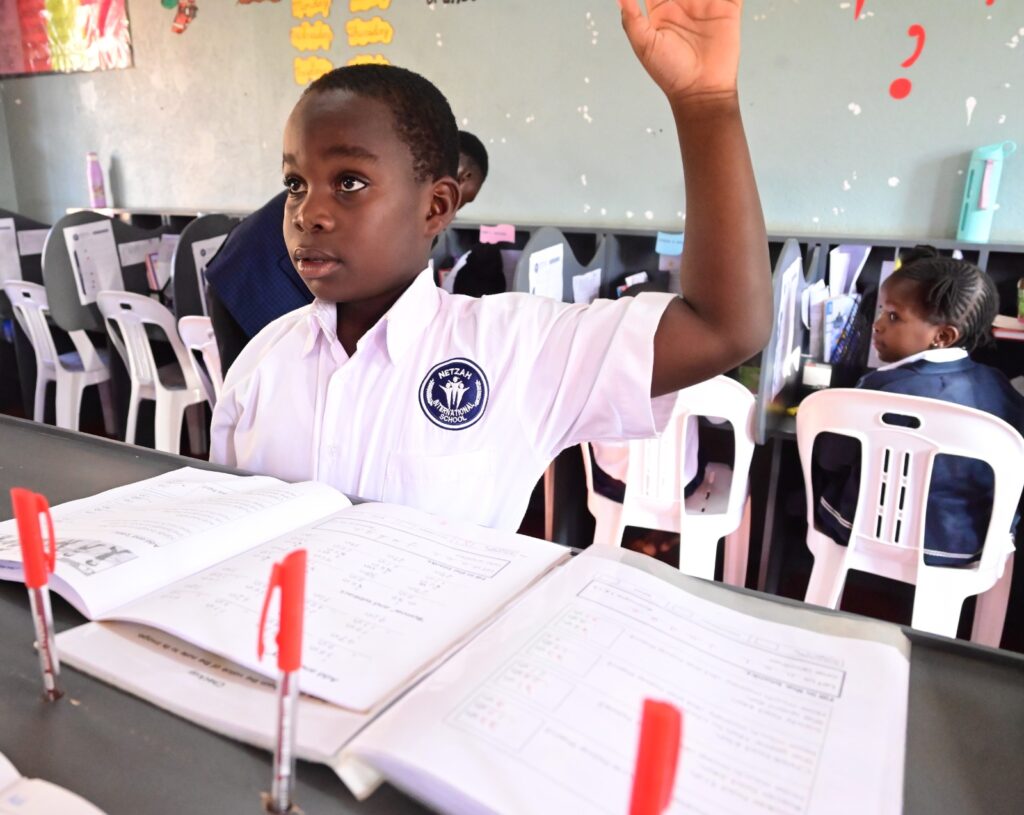
ACE Supervisors (teachers) circulate the classroom, respond to student flags (red = need help, blue = need a monitor), supervise PACE tests, and provide personalised guidance and encouragement. They also run group instructional sessions for certain subjects. The ratio of supervisor attention per student is often higher than in traditional classrooms.
In a traditional classroom, all children of the same age study the same content at the same pace — regardless of individual readiness. ACE places each child at their specific academic level in each subject, allowing those who are ahead to advance faster and those who need more time to master content properly. Biblical values and character formation are also intentionally integrated into every lesson, which is unique to ACE.
In a traditional classroom, all children of the same age study the same content at the same pace — regardless of individual readiness. ACE places each child at their specific academic level in each subject, allowing those who are ahead to advance faster and those who need more time to master content properly. Biblical values and character formation are also intentionally integrated into every lesson, which is unique to ACE.